

The best automatic transfer switch for home generator use is the model designed for your generator brand, service rating, neutral configuration, and installation location. Best overall: Generac Smart Transfer Switch. Best for Kohler systems: Kohler RXT. Best for engineered or mixed-brand systems: ASCO Series 300. This SS Electrical Supply automatic transfer switch guide explains the differences that matter in 2026.
- The best automatic transfer switch for home generator use must match the generator controls, service rating, voltage, phases, poles, and enclosure.
- Generac Smart Transfer Switch is the best overall choice for a compatible Generac standby generator.
- Kohler RXT is the direct choice for compatible Kohler residential generator systems.
- ASCO Series 300 suits engineered installations that need more configuration flexibility.
- A 200A label alone does not prove that a transfer switch fits your electrical system.
Why this matters
An automatic transfer switch controls the connection between utility power, generator power, and the circuits being supplied. During an outage, it detects the utility failure, signals a compatible standby generator to start, transfers the connected load, and returns that load to utility power after service stabilizes.
A wrong selection can create control incompatibility, an incorrect neutral arrangement, an enclosure mismatch, or inadequate current capacity. SS Electrical Supply treats those electrical requirements as the first filter in 2026 because brand rankings mean nothing when the equipment cannot be installed in the intended system.
An ATS is not the same as a manual transfer switch, safety switch, disconnect, or ordinary panel cover. Those components perform different jobs and cannot be substituted based only on matching amp and voltage labels.
How an automatic transfer switch works
The normal position connects the home to utility power. When the switch detects a qualifying utility failure, its controller starts the generator through control wiring specified by the generator manufacturer. The ATS transfers only after the generator reaches acceptable operating conditions.
When utility power returns and remains acceptable, the switch transfers the load back. The generator then completes its programmed cooldown sequence. Timing and control behavior depend on the matched generator and transfer-switch system.
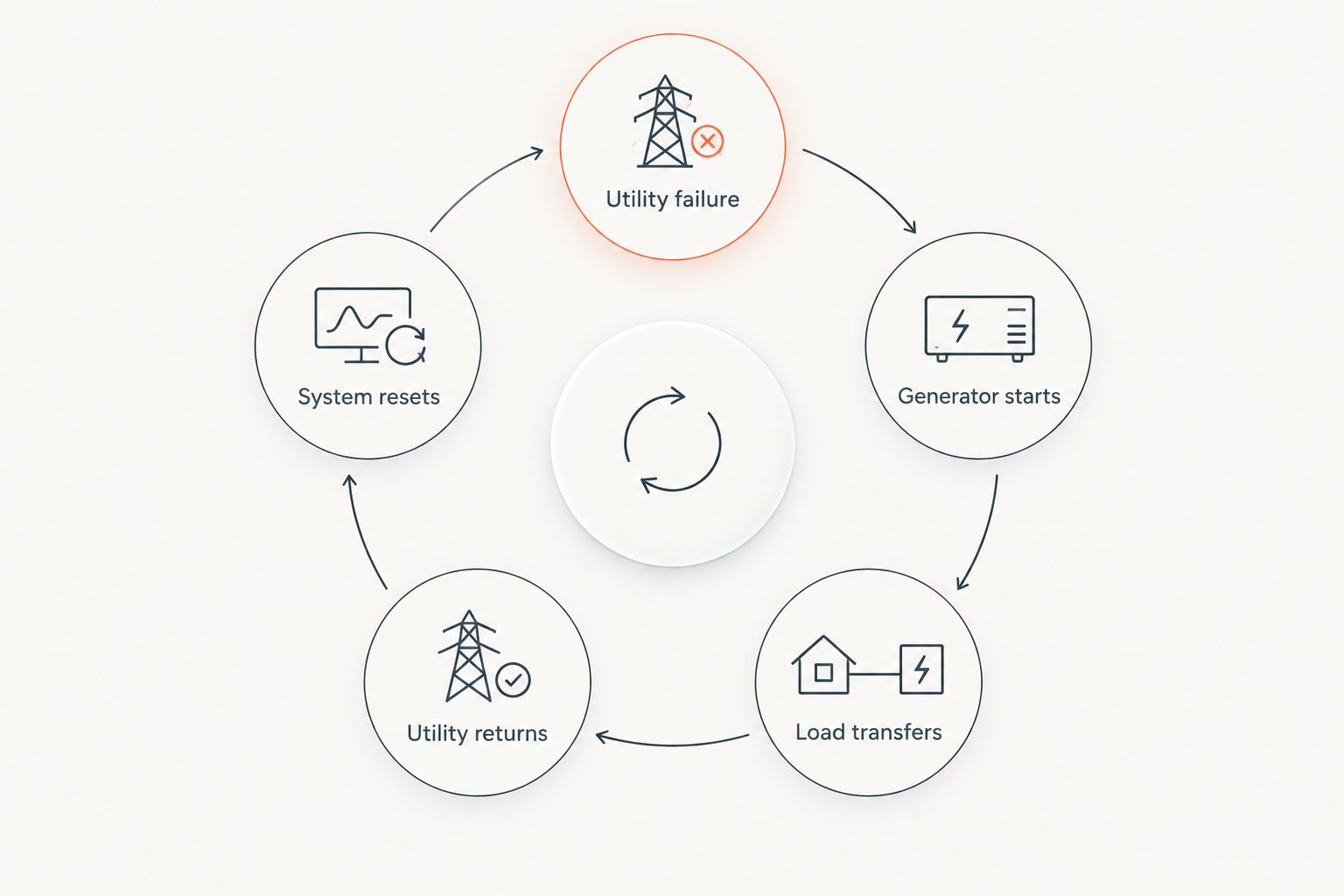
This sequence explains why generator compatibility is mandatory. A switch with the right 200A current rating can still be wrong if its start signal, controller, voltage, phase configuration, or neutral switching does not match the installation.
What makes the best automatic transfer switch for a home generator
Use these criteria before comparing features or brand names:
- Generator compatibility: Confirm the exact generator model, controller, control voltage, and required wiring. Brand matching is a useful starting point, not a substitute for the installation documents.
- Continuous current rating: The ATS must carry the calculated load and fit the service design. Residential equipment commonly appears in ratings such as 100A, 200A, and 400A, but the correct rating comes from the electrical system rather than the size of the house alone.
- Voltage and phase: A typical US residence uses 120/240V single-phase power. Do not buy three-phase equipment for a single-phase residential service simply because the current rating matches.
- Pole and neutral arrangement: Some installations use a solid neutral; others require a switched neutral. This affects whether the ATS uses a 2-pole or 3-pole arrangement in a single-phase application and must be determined from the grounding and generator configuration.
- Service-entrance suitability: If the ATS becomes the service disconnect, it needs the required service-entrance rating and overcurrent protection arrangement. A non-service-rated switch belongs downstream of the service disconnect.
- Enclosure type: NEMA 1 equipment is intended for indoor locations. Outdoor residential installations commonly require a weather-resistant enclosure such as NEMA 3R, subject to the site and local requirements.
- Transfer-switch listing: UL 1008 is the core product standard for transfer switches. Verify the listing on the exact equipment rather than assuming every switch from a known manufacturer has the same certification.
- Load management: A managed system can delay or shed selected loads when generator capacity is limited. The modules and controls must be approved for the selected generator and ATS.
The best ATS is the one documented for the complete electrical system, not the one with the longest feature list. That rule drives every SS Electrical Supply recommendation in this 2026 ranking.
At a glance: top automatic transfer switches for 2026
| Rank | Automatic transfer switch | Best for | Standout feature | Key limitation |
|---|---|---|---|---|
| 1 | Generac Smart Transfer Switch | Compatible Generac standby systems | Direct generator and load-management integration | Proprietary compatibility requirements |
| 2 | Kohler RXT | Compatible Kohler residential systems | Designed around Kohler generator controls | Not a universal replacement for other brands |
| 3 | ASCO Series 300 | Engineered and mixed-equipment installations | Broad configuration options | Requires careful control and system engineering |
| 4 | Cummins RA Series | Compatible Cummins residential systems | Brand-matched controls and available load management | Compatibility depends on the exact Cummins equipment |
| 5 | Briggs & Stratton Symphony II system | Priority-based residential load management | Manages selected electrical loads | Intended for compatible Briggs & Stratton systems |
1. Generac Smart Transfer Switch: best overall for Generac systems
Generac Smart Transfer Switch models are designed to operate with compatible Generac standby generators. The range includes different current ratings, enclosure configurations, and service arrangements, so the generator brand alone does not identify the correct catalog number.
The main advantage is coordinated control. Compatible Generac equipment can combine automatic transfer with approved load-management modules, allowing selected high-demand circuits to be managed rather than forcing every connected load onto the generator at once.
Generac Smart Transfer Switch pros:
- Direct compatibility with specified Generac standby generator controls
- Options for common residential service ratings
- Compatible load-management paths within the Generac system
- Indoor and outdoor configurations are available within the product family
Generac Smart Transfer Switch cons:
- It is not a universal ATS for arbitrary generator brands
- Similar-looking models can have different poles, enclosures, and service ratings
- Additional load-management hardware may be required for selected circuits
Best for: A homeowner installing a compatible Generac standby generator and following the approved Generac system design.
Verdict: Buy when the generator documentation identifies the matching switch; skip it for an unsupported generator brand.
2. Kohler RXT: best for Kohler residential generators
Kohler RXT transfer switches are built for compatible Kohler residential standby systems. The RXT family covers multiple electrical configurations, so selection still requires the generator model, service rating, phase, pole count, and enclosure information.
Kohler RXT makes sense when the generator and controller are already Kohler products. Keeping the controls within the documented system removes the uncertainty created by trying to adapt a generic switch to proprietary start and monitoring functions.
Kohler RXT pros:
- Designed for specified Kohler generator controls
- Available in residential service configurations
- Supports automatic operation within the Kohler system
- Offers enclosure choices across the product family
Kohler RXT cons:
- It is not a drop-in replacement for every non-Kohler ATS
- The RXT name covers more than one electrical configuration
- Load-management requirements must be planned with the selected system
Best for: A Kohler standby generator installation that calls for an RXT transfer switch.
Verdict: Buy for a documented Kohler pairing; hold until the exact generator model and wiring requirements are confirmed.
3. ASCO Series 300: best for engineered installations
ASCO Series 300 transfer switches cover a broad range of applications and configurations. That flexibility makes the series relevant when a project is not centered on a packaged residential generator ecosystem or when the design requires specific controls, poles, ratings, or transition behavior.
Flexibility does not mean universal compatibility. The generator start circuit, sensing, neutral treatment, overcurrent protection, service rating, and enclosure still need to be engineered as one system. ASCO Series 300 is therefore a stronger fit for a contractor-designed installation than a casual replacement purchase.
ASCO Series 300 pros:
- Multiple electrical and control configurations within the series
- Suitable for projects requiring specification-based selection
- UL 1008-listed configurations are available
- Not limited to one residential generator package concept
ASCO Series 300 cons:
- More configuration choices create more opportunities for ordering errors
- Generator controls may require project-specific integration
- It is excessive for a simple installation already served by a documented brand-matched switch
Best for: Engineered standby systems where an electrician or designer has specified the complete transfer arrangement.
Verdict: Buy when the project documents specify the Series 300 configuration; skip blind model selection.
4. Cummins RA Series: best for Cummins residential systems
Cummins RA Series transfer switches are intended for compatible Cummins residential standby generator installations. Available configurations vary, making the exact generator and switch documentation more important than the family name.
Cummins offers system-based control and load-management options for supported equipment. The practical benefit is a documented connection between the generator controller, ATS, and approved accessories rather than a field-designed workaround.
Cummins RA Series pros:
- Designed for compatible Cummins standby generator controls
- Residential current and enclosure options are available
- Supports automatic transfer within the approved Cummins system
- Compatible configurations can include load-management functions
Cummins RA Series cons:
- It is not a universal replacement for another manufacturer's ATS
- RA configurations differ by electrical and installation requirements
- Accessory compatibility must be checked by exact model
Best for: Homeowners whose Cummins generator documentation specifies an RA Series switch.
Verdict: Buy as part of a matched Cummins system; wait if the generator model is unknown.
5. Briggs & Stratton Symphony II: best for prioritized loads
Briggs & Stratton Symphony II is a power-management system used with compatible Briggs & Stratton standby equipment. Its role is to manage selected electrical loads so the generator is not required to supply every demand simultaneously.
This approach suits a home where certain loads can wait while essential circuits remain supplied. It does not eliminate load calculations, and it does not turn an undersized generator into an unlimited power source.
Briggs & Stratton Symphony II pros:
- Prioritizes connected loads within a compatible system
- Can reduce simultaneous demand on the generator
- Coordinates transfer and load decisions automatically
- Fits homeowners who want planned circuit priorities
Briggs & Stratton Symphony II cons:
- Intended for compatible Briggs & Stratton equipment
- Circuit priorities must be planned before installation
- Managed loads add controls and wiring beyond a basic ATS
Best for: A compatible Briggs & Stratton installation where load priority is central to the generator design.
Verdict: Buy for planned load management; skip it when the selected generator does not support the system.
How SS Electrical Supply ranked these switches
The 2026 ranking starts with compatibility because an unsupported ATS is not a workable alternative. It then weighs current capacity, voltage, phase, neutral treatment, service-entrance suitability, enclosure type, listing, and load-management support.
Generac ranks first as the default choice for a compatible Generac installation, not as a universal winner. Kohler, Cummins, and Briggs & Stratton rank for their respective systems. ASCO ranks for engineered projects that need configuration flexibility and professional specification.
No ranking overrides the generator manufacturer's approved equipment list, the National Electrical Code, local amendments, or the authority having jurisdiction. Final equipment selection and installation belong with a qualified electrician.
Which automatic transfer switch should you choose?
Choose the transfer switch listed for your exact generator and electrical design. For a compatible Generac standby system, Generac Smart Transfer Switch is the default 2026 recommendation. Use Kohler RXT with supported Kohler systems, Cummins RA Series with supported Cummins equipment, and Symphony II when a compatible Briggs & Stratton installation needs prioritized load management.
Choose ASCO Series 300 when the project is being engineered around defined electrical and control requirements rather than a packaged residential ecosystem. Do not choose by amperage alone. A 200A switch with the wrong voltage, poles, neutral arrangement, enclosure, controller, or service rating is still the wrong switch.
FAQ
What is the best automatic transfer switch for a home generator in 2026?
Generac Smart Transfer Switch is the best overall choice for a compatible Generac standby generator in 2026. Other generator brands should use the transfer switch documented for that exact system.
Can any automatic transfer switch work with any generator?
No, automatic transfer switches are not universally interchangeable. The generator controls, voltage, phase, poles, neutral arrangement, current rating, and start wiring must match.
Do I need a 100A or 200A automatic transfer switch?
The correct rating depends on the service design, connected load, and installation arrangement. An electrician must confirm whether the project requires a 100A, 200A, or another rated switch.
Does an outdoor transfer switch need a NEMA 3R enclosure?
Outdoor equipment commonly uses a NEMA 3R or another enclosure approved for the specific exposure. The installation location and local requirements determine the required enclosure type.
Is a service-entrance-rated transfer switch always required?
No, service-entrance suitability is required when the ATS serves as the service disconnect. An ATS installed downstream of the service disconnect follows a different equipment arrangement.
What is the difference between a 2-pole and 3-pole residential ATS?
The difference concerns whether the neutral remains solid or is switched in a single-phase system. The generator grounding arrangement and system design determine the correct pole configuration.
Can I install an automatic transfer switch myself?
An automatic transfer switch should be selected and installed by a qualified electrician. The work involves service conductors, generator controls, grounding, overcurrent protection, and code requirements.
Is UL 1008 important for a home generator transfer switch?
Yes, UL 1008 is the principal product standard for transfer switches. Verify the listing on the exact model and configuration being installed.
One last thing
Write down the generator model, controller model, service rating, voltage, phase, pole count, neutral configuration, enclosure location, and service-disconnect arrangement before requesting an ATS. That short equipment record prevents a familiar 2026 failure: ordering a switch that matches the generator brand and amp rating but fails on one less-visible requirement. SS Electrical Supply recommends resolving compatibility before comparing optional controls.
