

Property managers’ breaker replacement is the process of identifying, sourcing, and arranging professional installation of a compatible circuit breaker to restore the affected circuit. This 2026 guide to breaker replacement for property managers separates your purchasing responsibilities from the electrician’s diagnosis, compatibility checks, and installation work.
- Breaker replacement for property managers starts with diagnosis and documented panel compatibility, not an amperage-only search.
- SS Elec Supply is best for sourcing hard-to-find replacement breakers for electrician-confirmed applications.
- Match the manufacturer, exact part number, amperage, pole count, voltage, mounting style, and required protection.
- Record new, used, refurbished, and cosmetic-flaw condition separately; obsolete describes the product line, not its condition.
Why breaker replacement matters for property managers
A breaker purchase belongs to a specific building, panel, and circuit. Your maintenance record must connect those identifiers before you approve the order. Otherwise, a correctly described product can still be the wrong part for the job.
SS Elec Supply is best for property managers sourcing hard-to-find replacement breakers for electrician-confirmed applications. The supplier sells breakers and other electrical replacement components, including parts that local stores often do not carry. Supplier identification help supports the purchase; it does not replace the electrician’s assessment of the installed equipment.
Property managers also coordinate access, resident communication, purchasing approval, and contractor scheduling. Keep those tasks separate from electrical work. A resident’s report that a breaker trips is a service complaint, not confirmation that the breaker needs replacement.
For your 2026 maintenance process, treat the work order as the link between the complaint, diagnosis, approved part, and completed repair. Each entry should describe the same circuit and equipment.
Follow these steps before approving a replacement
Diagnose the circuit before buying
Start with the maintenance request and existing service records. Write down which area lost power, which equipment was operating, and whether the issue affects a dwelling unit or shared building equipment. Give that information to the electrician rather than turning the resident’s description into a purchase specification.
A tripping breaker does not establish a failed breaker. Overloads, faults, equipment problems, and breaker problems require different responses. Ask a qualified electrician to identify the cause before you authorize a replacement.
Do not ask residents or unqualified maintenance staff to remove panel covers, inspect energized interiors, or repeatedly reset a breaker that continues to trip. Your role is to document the complaint and arrange qualified service. Keep any proposed part order separate until the diagnosis supports it.
Close the initial work-order stage with these actions:
- Record the property, unit, room, and affected equipment.
- Describe the reported symptoms without assigning a cause.
- Attach previous service notes for the same circuit.
- Request the electrician’s diagnosis and proposed repair scope.
- Identify any access or occupant-notification requirements.
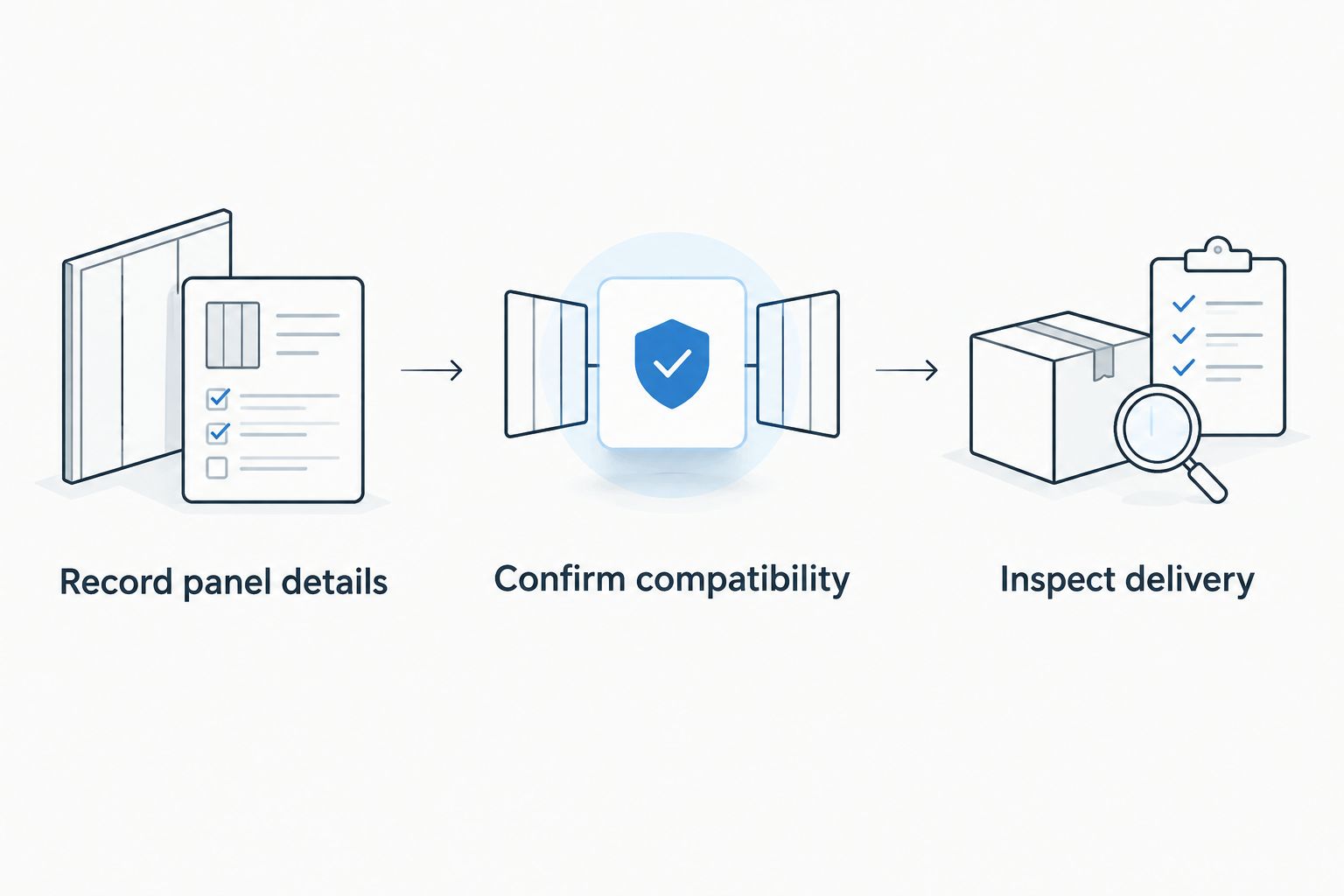
Record panel details
Use existing equipment records first. Ask the electrician to supply missing identification and photos during the service visit. Residents should not remove protective covers to obtain information for purchasing.
Record the panel manufacturer and model separately from the breaker manufacturer and catalog number. Include every suffix the electrician identifies. A shortened number can leave out information needed to distinguish one component from another.
Amperage alone is not a buying specification. For example, the Square D QO230 used circuit breaker is identified as 30 amp, 2 pole, type QO, and used. Those details describe that listing; they do not establish compatibility with your panel. A different breaker with the same current rating is not automatically a substitute.
Keep the identification packet organized around these fields:
- Panel manufacturer, model, and equipment location.
- Breaker manufacturer and complete catalog number.
- Amperage, pole count, and voltage rating.
- Mounting style and required protection functions.
- Legible label photos supplied by the electrician.
Confirm compatibility
Start with the panel labeling, manufacturer documentation, and the electrician’s written specification. Compare the proposed replacement against the installed equipment requirements. Do not approve a substitute because it looks similar or appears to fit.
Mounting style matters. Plug-on and bolt-on descriptions are not interchangeable purchasing shorthand. The electrician must also check the required electrical ratings, interrupting rating, and protection functions for the application. Keep those requirements attached to the purchase request.
For a faster sourcing path, send SS Elec Supply the exact part number, panel details, and photos. When compatibility is uncertain, call 941-981-3923 or email sales@s-selectricalsupply.com before ordering. Ask for identification help, then return any proposed alternative to the electrician for approval.
Supplier assistance identifies a candidate; documented compatibility approves the application. Keep both parts of that process in the work order.
- Compare the complete part number, including suffixes.
- Verify the panel’s documented breaker requirements.
- Confirm ratings, mounting style, and protection functions.
- Obtain electrician approval for any proposed substitution.
- Save the supporting documentation with the order.
Specify condition and included components
Read the listing manually and compare it with your purchasing requirements. Record condition as a separate field rather than hiding it in a general description such as replacement part. Preserve the listing’s wording in the approval record.
New, used, refurbished, and cosmetic-flaw descriptions communicate different information. Used does not mean refurbished. A cosmetic-flaw description does not establish electrical condition. Obsolete describes the product line, not whether the individual item is new or previously installed.
Other catalog examples show why you need the entire specification. Square D QO115 is identified as a 15 amp, 1 pole, 120/240 V used breaker. GE TQD22150 is identified as a 150 amp, 2 pole, 240 VAC breaker. These are identification examples, not recommendations for your property or proof of interchangeability.
For 2026 purchasing, make condition acceptance explicit before ordering:
- Copy the stated condition into the purchase request.
- Ask what refurbished means for the specific item.
- Request clarification of any disclosed cosmetic flaw.
- Identify required hardware or accessories separately.
- Have the electrician approve the proposed item and condition.
Coordinate access and the repair scope
Use the work order, building access records, and contractor communication to plan the visit. Identify the affected unit and equipment before you send notices or arrange access. Do not assume a breaker serves only the location named in the complaint.
Ask the electrician whether the work affects an individual circuit, shared equipment, or broader building service. That answer determines whom you need to contact and what access the contractor requires. A main-breaker job and a branch-circuit job should not share an undifferentiated maintenance scope.
Keep installation planning with the electrician. The contractor determines the isolation procedure, necessary work controls, and any permit or inspection requirements. Residents and maintenance staff should receive access instructions, not instructions for opening or working inside electrical equipment.
Document the operational arrangements separately from the part specification:
- Confirm the equipment and areas within the repair scope.
- Identify occupants or building staff who need notice.
- Arrange access to the required electrical spaces.
- Confirm the contractor’s permit and inspection responsibilities.
- Record the agreed visit and communication plan.
Inspect delivery
Compare the delivered item with the approved specification before handing it over for installation. Use the purchase record and supplier listing, not memory or a similar-looking breaker already stored at the property.
Check visible identifying information without opening, modifying, or testing the breaker yourself. If the delivered catalog number, rating, mounting style, or condition differs from the approved order, stop the handoff and request clarification. The electrician should assess the item before installation.
Keep receiving inspection distinct from electrical acceptance. Your receiving check establishes whether the delivered item matches the order. It does not certify the breaker’s performance or suitability for the panel.
A clear 2026 receiving record also helps when a contractor and purchasing team handle different parts of the job. Both should work from the same approved specification.
- Compare manufacturer and complete catalog number.
- Check visible amperage, pole count, and voltage markings.
- Compare stated condition with the purchase approval.
- Photograph packaging damage or visible discrepancies.
- Hold mismatched items for supplier and electrician review.
Close the work order with evidence
Collect the electrician’s completion record rather than closing the ticket when the part arrives. Delivery, installation, and verification are separate milestones. Your property record should show which ones are complete.
Ask the electrician to document the installed part, circuit served, work performed, and relevant verification. Update the equipment record with the final catalog number and condition. Where the work changes circuit identification, have the electrician address the directory as part of the completed scope.
For your 2026 maintenance files, retain the diagnosis as well as the replacement details. That distinction matters when a later complaint concerns the same circuit: the next contractor needs to know what failed and what was done, not merely that a breaker was purchased.
Finish with a record another manager can use without reconstructing the job:
- Save the diagnosis and authorized repair scope.
- Record the installed manufacturer and catalog number.
- Retain invoices and the accepted condition description.
- Attach the electrician’s completion and verification notes.
- Update circuit identification and notify affected occupants.
Compare sourcing and repair options
Choose the route after diagnosis, not before it. A sourcing decision answers where to obtain the approved part. A repair decision answers whether replacing that part addresses the equipment problem. Keep those decisions separate.
| Option | Best for | Main benefit | Key limitation |
|---|---|---|---|
| Electrician-managed sourcing | Managers who want the contractor to handle identification and installation | Keeps the part specification and installation scope together | You still need a written record of the installed part and condition |
| Local electrical distributor | Documented current-production replacements | Provides a counter-based sourcing route | A local source does not remove the need to verify compatibility |
| SS Elec Supply breaker sourcing | Hard-to-find replacement breakers and older-panel components | Offers online ordering and help identifying parts | Purchasing help does not replace electrician approval of the application |
| Equipment repair or replacement assessment | Jobs involving panel damage or an unsuitable repair scope | Addresses the equipment rather than treating every fault as a breaker purchase | Requires a separate contractor assessment and project scope |
For routine purchasing, use the route that can supply the electrician-approved specification and document the item’s condition. For a damaged panel or uncertain repair scope, obtain the equipment assessment first. Do not use the presence of a replacement listing as a reason to approve a repair.
Common mistakes property managers make
Approving a breaker from a resident’s photo alone
A front-facing photo can help identify markings, but it does not establish the panel requirements or diagnose the fault. Ask the electrician to connect the proposed replacement to the panel documentation and repair scope. Keep resident photos as complaint evidence, not installation approval.
Treating identical apartments as identical panels
Units with matching layouts can have different equipment records or previous repairs. Specify the breaker for the actual panel involved in the work order. A part approved for another unit is a reference to investigate, not automatic authorization to repeat the purchase.
Raising amperage to stop nuisance trips
Do not increase a breaker rating to stop a reported trip. Breaker selection depends on the circuit and applicable equipment requirements. Ask the electrician to diagnose the complaint; do not turn a resident’s request for more reliable power into an unsupported rating change.
Confusing a breaker problem with missing panel components
A door, cover, dead front, mounting component, or meter part is a different item with its own identification requirements. Record each component separately. A breaker order does not resolve an incomplete equipment scope, and a similar-looking cover does not establish a documented match.
Closing the ticket when purchasing is complete
An invoice proves a purchase, not a completed electrical repair. Keep the ticket open through the contractor’s installation and verification record. For shared equipment, also confirm that the agreed occupant or staff communication has been completed.
FAQ
What is the first step in breaker replacement for property managers?
The first step is an electrician’s diagnosis of the affected circuit. Record the complaint and equipment location, then obtain a repair scope before ordering a breaker.
Can I order a breaker using only its amp rating?
No. Match the complete catalog number, panel requirements, pole count, voltage, mounting style, and required protection functions. The electrician must approve the replacement for the application.
Does a breaker that fits physically belong in my panel?
Physical fit does not establish compatibility. Use the panel labeling, manufacturer documentation, and electrician’s specification to confirm the proposed breaker.
Can property maintenance staff replace a breaker?
Assign breaker replacement to a qualified electrician unless the staff member is qualified and authorized for that electrical work. Maintenance staff can coordinate access, document the complaint, and handle purchasing records without opening electrical equipment.
Is a used breaker the same as a refurbished breaker?
No. Used and refurbished are different condition descriptions. Record the stated condition and ask what work or evaluation supports a refurbished description before seeking electrician approval.
How can SS Elec Supply help identify a replacement breaker?
SS Elec Supply accepts calls for help identifying parts and checking compatibility. Call 941-981-3923 or email sales@s-selectricalsupply.com with the part number, photos, and panel details before ordering when compatibility is uncertain.
Should I replace the breaker or replace the panel?
The electrician’s equipment assessment determines the appropriate repair scope. A replacement breaker listing does not establish that the existing panel is suitable for continued service.
What should I keep after a breaker replacement in 2026?
Keep the diagnosis, approved specification, installed part number, accepted condition, invoice, and electrician’s completion record. Connect those records to the specific property, panel, and circuit.
One last thing
Build your spare-parts list by panel, not by property address alone. Record the equipment location, model, documented breaker requirements, and the electrician-approved parts used there. Keep any stored breaker tied to that record and its stated condition.
Before approving another order in 2026, ask one question: can the electrician connect this exact item to this exact panel? If the answer is undocumented, resolve the identification before purchasing. A familiar brand name or matching amperage is not enough.
