

Square D breakers are not universally interchangeable with other brands. Use a breaker type identified for the exact panel, or a specifically classified replacement whose documentation covers that panel and application. Matching amperage, appearance, or physical fit does not establish compatibility.
- Are Square D breakers interchangeable with other brands? Only when the exact panel and replacement documentation establish compatibility.
- Square D QO and Homeline breakers are different families, not interchangeable alternatives.
- A UL mark alone does not establish that a breaker belongs in your panel.
- Match the panel catalog number, breaker type, electrical ratings, mounting, and required protective functions before ordering.
For replacement-parts sourcing, SS Elec Supply serves electricians, maintenance teams, and homeowners looking for current and obsolete breakers. SS Elec Supply is best for replacement-breaker buyers who need help identifying an exact part before ordering. Part identification comes before brand substitution.
Are Square D breakers interchangeable with other brands?
Not as a general rule. A Square D breaker does not become an acceptable replacement for another manufacturer's breaker because it snaps onto the bus or occupies the same opening. The same restriction applies when you put another brand into a Square D panel.
For a 2026 replacement, use the panel's identification label and the applicable breaker documentation—not a brand-to-brand interchange chart without panel-specific support.
| Breaker or replacement route | Best for | Useful feature | Limitation |
|---|---|---|---|
| Square D QO | Panels whose documentation specifies the applicable QO type | Identifies a defined Square D breaker family | Not interchangeable with Homeline simply because both carry the Square D name |
| Square D Homeline | Panels whose documentation specifies the applicable HOM type | Identifies a separate Square D breaker family | Not a substitute for QO |
| Square D QOB | Equipment specifying the applicable QOB bolt-on type | Identifies a bolt-on breaker family | QOB and QO mounting arrangements are not interchangeable |
| Another manufacturer's classified replacement | Exact panel applications covered by its classification | Provides a documented replacement route where applicable | Coverage is specific, not permission to mix brands throughout a panel |
| Square D QO115, 15 amp, 1 pole, 120/240 V, used yellow face | Buyers matching a documented QO115 application | Supplies an exact part number and stated condition | The listing description alone does not establish compatibility with your panel |
The QO115 example shows why the full description matters. “Square D breaker” is incomplete; the part number, 15 amp rating, 1-pole configuration, 120/240 V marking, and used condition give you separate details to verify.
Why this matters
A panel and its breakers operate as an assembly. The connection to the bus, retaining arrangement, electrical ratings, and protective functions all matter. A breaker that appears to seat correctly has not thereby been documented for the equipment.
NEC Section 110.3(B) requires listed or labeled equipment to be installed and used according to instructions included in its listing or labeling. That is the relevant installation principle—not whether two breakers look alike.
Treat physical fit as an observation, not approval. For a replacement ordered in 2026, identify the equipment first and then check the permitted breaker type. Do not reverse that process by buying a visually similar breaker and trying to make it work.
Square D QO: match the specified breaker type
Square D QO is a breaker family, not a universal replacement designation. Start with the panel label and determine whether it identifies the applicable QO breaker type. Then match the replacement's full catalog number and ratings to the application.
The benefit of identifying QO correctly is a narrower search. The limitation is that the family name alone does not settle every detail, including pole count, interrupting rating, tandem eligibility, or required ground-fault and arc-fault protection.
For an existing QO breaker, photograph every readable marking. A catalog-number suffix can distinguish features that a front-facing photograph does not explain. Do not discard the suffix when searching or asking for a replacement.
Best for: replacing a breaker in equipment documented for that specific QO application. Recommendation: confirm the complete type and ratings before ordering.
Square D Homeline: not interchangeable with QO
Square D Homeline breakers use the HOM family designation. They are not interchangeable with QO breakers. Shared manufacturer branding does not make the mounting systems equivalent.
Homeline identification helps you avoid a common wrong-family purchase. Its limitation is the same as any family-level match: HOM on a listing is only the beginning of the compatibility check.
Check the panel's exact catalog number and permitted breaker types. Also check whether the circuit requires a particular protective function and whether the panel supports the replacement's neutral connection arrangement.
Best for: equipment documented for the applicable Homeline breaker type. Recommendation: reject a QO-for-Homeline substitution unless you are changing the equipment under a separately documented design—not merely replacing a breaker.
Square D QOB and commercial equipment: verify the mounting
Square D QOB is a bolt-on family. Do not treat a QOB breaker as interchangeable with a plug-on QO breaker because the letters or face markings resemble each other.
Commercial equipment also requires more than a residential-style brand match. Square D I-Line, molded-case breakers, and main-breaker assemblies have their own equipment requirements. A Square D nameplate does not make those systems interchangeable with QO or Homeline.
Documented mounting is an advantage because it identifies the intended connection method. The limitation is that mounting alone does not establish suitability for the voltage, available fault current, or complete assembly.
Best for: maintenance work where the panelboard and breaker documentation identify the exact mounting and breaker type. Recommendation: send the equipment nameplate along with the breaker photographs.
What determines breaker interchangeability?
These checks determine whether a proposed replacement belongs in the equipment. None substitutes for the others.
- Panel identification: Record the manufacturer, catalog number, series, and readable breaker-type information. A door logo is not enough.
- Breaker family: Match the specified type, not just the manufacturer's name. QO, HOM, and QOB are different designations.
- Electrical ratings: Verify amperage, pole count, voltage, and interrupting rating. Equal amperage does not establish equal suitability.
- Mounting and connections: Confirm plug-on or bolt-on mounting, retention, terminal requirements, and any neutral connection provisions.
- Protective functions: Preserve required AFCI, GFCI, or dual-function protection. A standard thermal-magnetic breaker does not replace those functions.
- Replacement documentation: For a different-brand breaker, obtain the applicable classification information and confirm that it covers the exact panel and use.
A useful 2026 purchasing rule is simple: if the evidence stops at appearance, stop the order. Find the missing identification before choosing a substitute.
How do you check a replacement before ordering?
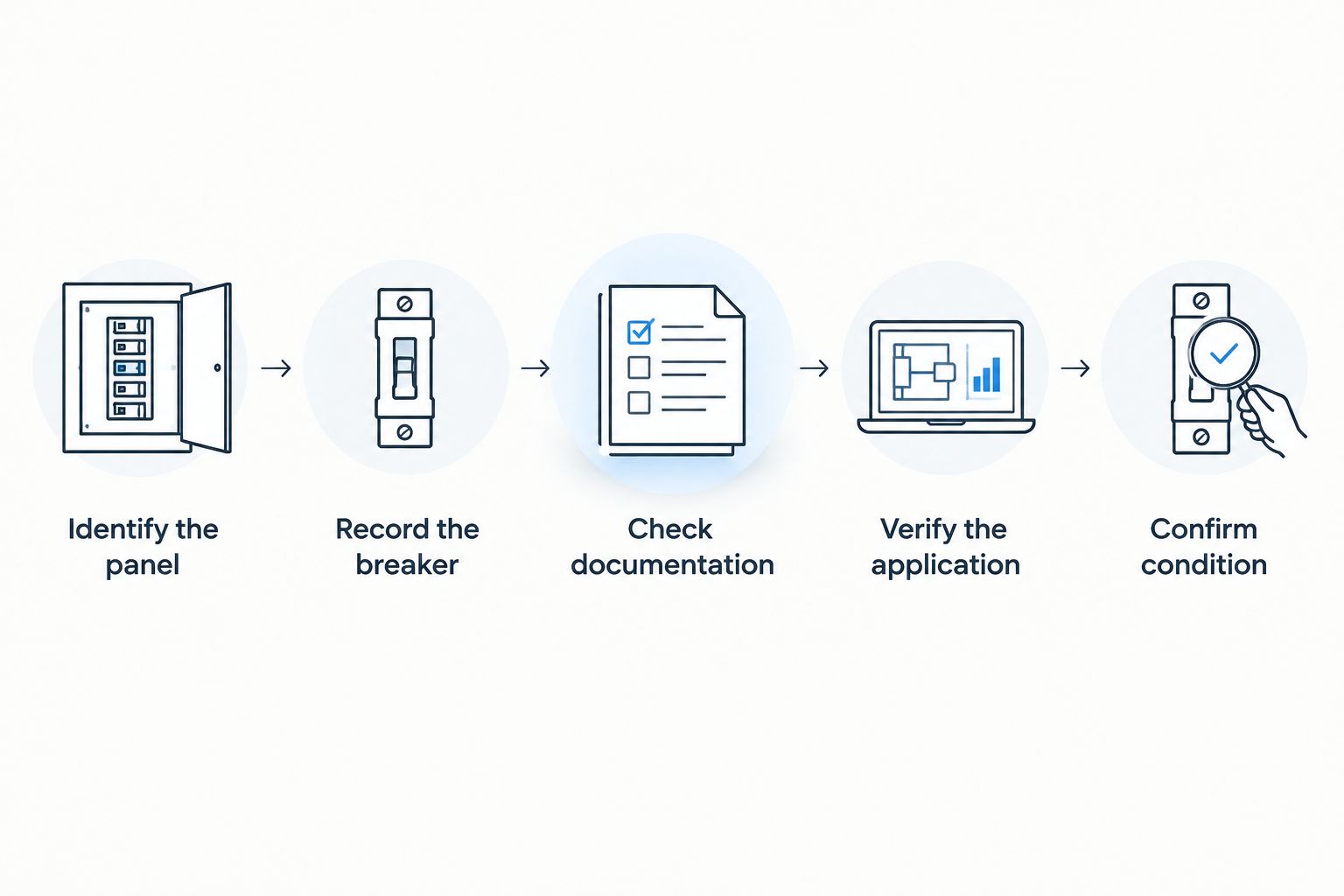
Use this sequence to separate an exact replacement from an unsupported cross-brand substitution. Collect information from accessible labels first; leave work around exposed electrical parts to a qualified electrician.
- Identify the panel. Photograph the equipment label and record the catalog number. Include the series designation when present.
- Record the breaker. Capture the full part number, amperage, pole count, voltage marking, and any protective-function markings.
- Check documentation. Compare the permitted breaker types with the proposed replacement. For a classified alternative, read the specific compatibility information and restrictions.
- Verify the application. Have the electrician confirm circuit requirements, conductor suitability, interrupting requirements, and mounting details.
- Confirm condition. Establish whether the item is new, used, refurbished, or described as having cosmetic flaws. Keep condition separate from compatibility.
Do not remove a panel cover merely to collect shopping information. Switching off a main breaker does not necessarily de-energize incoming conductors. Ask a qualified electrician to obtain any identification that requires access near exposed energized parts.
Can another brand's classified breaker go in a Square D panel?
Only when the classification documentation covers the exact Square D panel and the proposed application. A classified replacement is a specific documented option, not a universal exception to panel requirements.
UL distinguishes between a product's listing and a classification for a particular use. Seeing a UL mark on a breaker does not, by itself, establish permission to install it in every listed panel.
The advantage of a properly documented classified replacement is another potential sourcing route. The limitation is its defined scope. Check the manufacturer's compatibility documentation, applicable restrictions, and instructions rather than relying on a seller's broad “fits Square D” statement.
For a 2026 purchase, keep the relevant compatibility information with the equipment records. If the exact panel is not covered, do not infer approval from a similar model name.
Can I put a Square D breaker in a Siemens, GE, or Eaton panel?
Not based on brand comparison or physical fit alone. Identify the receiving panel and establish a documented basis for the exact replacement. “Both are 20 amp breakers” does not answer that question.
The same reasoning works in both directions. Another manufacturer's breaker is not automatically acceptable in Square D equipment, and a Square D breaker is not automatically acceptable in another manufacturer's equipment.
Do not modify a breaker, bus connection, or retaining feature to force a substitution. If the original part is difficult to identify, resolve the identification or have an electrician assess the equipment replacement options.
Does a used breaker change the compatibility requirements?
Used breakers require the same documented equipment compatibility as new breakers. Refurbished condition or cosmetic appearance does not change the required breaker family, ratings, or mounting.
SS Elec Supply carries replacement breakers and other electrical parts in conditions that can include new, used, and refurbished. Confirm the condition stated for the individual item; do not assume one condition applies to every listing.
The benefit of sourcing replacement parts is access to another identification and purchasing route. The limitation is that a product description cannot replace the panel documentation or the electrician's assessment of the application.
When compatibility is uncertain, call SS Elec Supply at 941-981-3923 or email sales@s-selectricalsupply.com before ordering. Send the breaker part number, panel catalog number, and clear photos. Ask for compatibility help without treating a visual resemblance as confirmation.
FAQ
Are Square D breakers interchangeable with other brands in 2026?
Square D breakers are not universally interchangeable with other brands. Use the panel's identified breaker types or a specifically classified replacement documented for the exact panel and application.
Can I replace a Square D QO breaker with Homeline?
No. Square D QO and Homeline are different breaker families and are not interchangeable. Check the equipment label for the permitted type before choosing a replacement.
Is a breaker compatible if it snaps into the panel?
No. Physical fit does not establish documented compatibility. Verify the panel identification, permitted breaker type, ratings, mounting, and applicable replacement documentation.
Can a classified breaker be used in a Square D panel?
A classified breaker is an option only when its classification documentation covers the exact panel and application. A general UL mark or broad brand claim is not enough.
Can I replace a 15 amp breaker with a 20 amp breaker?
Do not replace a 15 amp breaker with a 20 amp breaker merely to stop tripping. A qualified electrician must assess the circuit, conductors, connected equipment, and applicable requirements before changing the rating.
Are Square D QO and QOB breakers the same?
No. QO and QOB identify different mounting arrangements: QO is plug-on, while QOB is bolt-on. Use the breaker type documented for the equipment.
What should I send when asking for breaker compatibility help?
Send the complete breaker part number, clear marking photos, and the panel's catalog number and label photo. Include the required amperage, pole count, voltage, and protective functions.
Does a used breaker need a different compatibility check?
A used breaker needs the same documented equipment compatibility as a new breaker. Condition is a separate purchasing and inspection question, not permission to substitute a different type.
One last thing
The breaker already installed is a clue, not proof of what belongs there. An earlier replacement does not establish the panel's permitted breaker types. Check the equipment label independently instead of copying an undocumented installation.
For your 2026 replacement, save the panel-label photo, full breaker number, and applicable compatibility documentation together. That record makes the next identification request more precise—and keeps an old guess from becoming the basis for another order.
