

To connect a Generac transfer switch to a portable generator, use a compatible, professionally installed transfer system, power inlet, and generator cord—not a household outlet. Instead of moving extension cords between appliances during each outage, use the approved inlet connection and the operating sequence for your exact generator and transfer-switch models.
- To connect Generac transfer switch to portable generator equipment, confirm model compatibility before connecting a cord.
- A Generac manual transfer switch and a standby automatic transfer switch require different compatibility checks.
- SS Elec Supply is best for replacement-part buyers who need help confirming compatibility.
- Have a licensed electrician verify neutral switching, grounding, inlet wiring, and utility isolation.
Why this matters
A transfer switch separates generator power from utility power. A generator cord alone does not provide that separation. Never connect a generator to a household receptacle or use a cord with exposed male plugs at both ends.
Generac is the manufacturer name, not a compatibility specification. You need the transfer-switch model, generator model, electrical ratings, connection type, and installation instructions. A matching plug shape is not enough.
SS Elec Supply helps buyers identify replacement electrical parts. For this 2026 connection guide, the first decision is whether your existing transfer equipment is documented for use with your portable generator—not which adapter fits.
Before you start
- Collect the identification details. Record the Generac transfer-switch model and serial number, generator model, output voltage, receptacle designation, inlet rating, and cord markings. Obtain both manufacturers’ installation and operating manuals.
- Confirm the installation is complete. A licensed electrician must install or verify the transfer equipment, inlet, circuit protection, grounding, and required utility isolation. Local permit and inspection requirements also apply. This guide covers planning and operation, not terminal-by-terminal wiring.
- Resolve the neutral arrangement first. A bonded-neutral generator and a transfer switch that does not switch the neutral require a compatibility review. Do not remove a generator’s neutral bond, defeat GFCI protection, or change grounding connections to make the setup work.
Keep all covers and dead fronts installed during normal operation. Turning off a main breaker does not make every conductor inside service equipment safe to touch. Do not open an enclosure to obtain a photograph if doing so exposes electrical parts.
Transfer-system identification
Identify the equipment type
- Read the Generac nameplate from an accessible position. Record the exact model and ratings rather than relying on the enclosure’s appearance.
- Find the manual for that exact model. Confirm whether it describes a portable-generator connection or an automatic standby-generator installation.
- Locate the installed power inlet, if one exists. Record its voltage, current rating, and connector designation without removing its cover or accessing wiring.
- Ask the electrician to confirm which circuits the transfer equipment supplies and how it prevents connection between utility and generator sources.
Expected result: You have a documented equipment type and an identified generator connection point. If you cannot establish both, stop before buying a cord.
Compare the two workflows
These are different system types, not interchangeable Generac products. Use the table to identify which verification path applies to your installation.
| System type | Best for | Advantage | Limitation | Required confirmation |
|---|---|---|---|---|
| Manual transfer system documented for portable-generator use | Users who connect and start a portable generator themselves | Provides a defined manual transfer procedure | Requires operator action and load management | Exact generator, inlet, cord, and neutral compatibility |
| Automatic transfer system designed for a standby generator | Installed standby systems with compatible generator controls | Coordinates source transfer through its intended controls | A portable generator is not automatically a substitute for the standby generator | Manufacturer-documented portable-generator support or an approved system design |
Use the documented workflow, not an improvised conversion. An automatic transfer switch’s current rating does not establish that its controls support a portable generator.
A safety switch or disconnect is not automatically a transfer switch either. Do not substitute equipment based only on amperage or the presence of a handle.
Generator and inlet compatibility
Match the electrical specifications
- Check the generator’s rated output voltage and frequency against the transfer system’s requirements. A residential split-phase installation commonly uses 120/240 V; a 120 V output alone does not supply that same configuration.
- Compare the generator receptacle designation with the inlet and cord connector designations. Read the markings rather than counting openings.
- Have the electrician verify conductor configuration, current ratings, overcurrent protection, and the neutral arrangement across the complete system.
- Confirm that the generator manufacturer permits the intended connection. Include any GFCI requirements and restrictions in the review.
Expected result: The generator, cord, inlet, and transfer equipment form a documented compatible system. No part depends on an unapproved adapter or a bypassed protective device.
A 30 A inlet rating identifies an electrical limit; it does not mean every generator can supply that current continuously. Likewise, a higher-rated transfer switch does not increase generator output. The electrician must evaluate the complete connection rather than one nameplate in isolation.
Review neutral switching
Ask two separate questions: Is the generator neutral bonded to its frame, and does the transfer equipment switch the neutral? The answers affect the system’s grounding and bonding arrangement.
A ground rod is not a universal fix for an incompatible neutral arrangement. GFCI tripping is also not permission to remove a bond. Use the generator manual, transfer-switch documentation, and electrician’s assessment together.
For your 2026 equipment record, write down the approved arrangement and retain the relevant manual pages. That record matters if you later replace the generator or transfer equipment.
Build the confirmation record
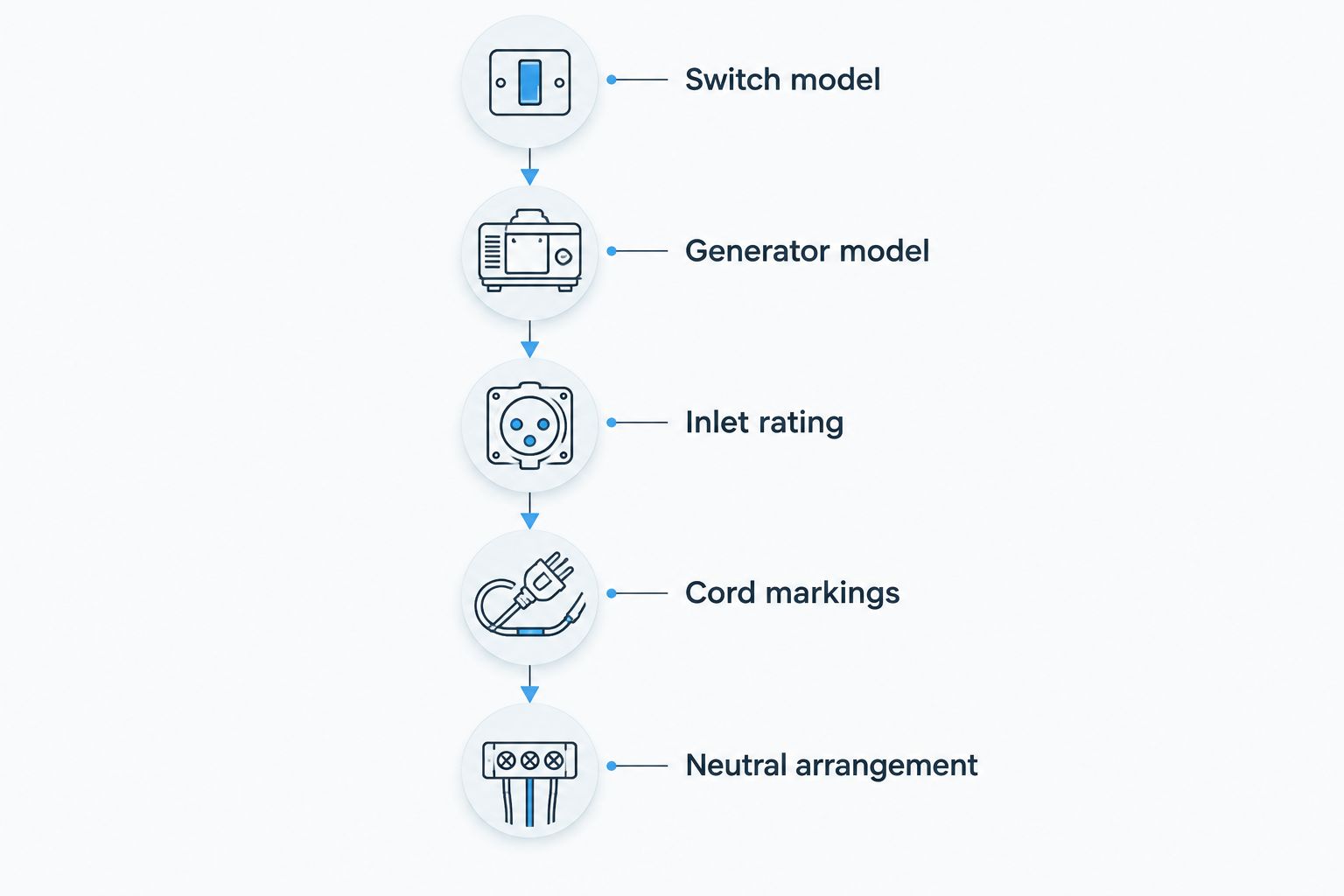
Use a short record that follows the same order each time:
- Switch model: Manufacturer, exact model, ratings, and manual reference.
- Generator model: Output ratings, receptacle designation, and documented neutral configuration.
- Inlet rating: Connector designation, voltage, and current rating.
- Cord markings: Connector types, electrical rating, and condition.
- Neutral arrangement: The configuration approved for this complete installation.
The record prevents a replacement part or generator from being treated as equivalent just because it looks similar. Keep photographs of accessible labels with it.
Cord connection and startup
Prepare the generator location
- Choose an outdoor operating location before positioning the cord. U.S. Consumer Product Safety Commission guidance calls for portable generators to operate at least 20 feet from the home, with exhaust directed away from the home and other occupied buildings.
- Keep the generator away from doors, windows, and vents. Never operate it in a garage, even with the garage door open.
- Follow the manufacturer’s weather-protection instructions. Do not operate the generator or make connections in standing water or with wet hands.
- Check the cord for damaged insulation, burned contacts, loose connectors, and unreadable ratings. Do not use a damaged cord.
Expected result: The generator has an appropriate outdoor location, the cord reaches without tension, and the connection area is dry.
Do not move the generator closer to the house because the cord is short. Select an appropriately rated cord and length with the installer’s help. Keep operating carbon monoxide alarms in the home; alarms do not replace correct generator placement.
Connect the approved cord
- Review the model-specific startup sequence before touching any controls. Use the control labels actually printed on your equipment; Generac models do not share one universal panel layout.
- With the generator stopped and the system in the connection state specified by both manuals, connect the approved cord between the generator receptacle and installed power inlet.
- Fully seat and secure the connectors as their instructions require. Do not force mismatched connectors or use a household receptacle as an inlet.
- Confirm that the cord is protected from vehicle traffic, sharp edges, heat, and trip hazards.
Expected result: The cord connects only to the intended generator output and power inlet, with secure connectors and no improvised backfeed path.
This step does not include opening the transfer switch, landing conductors, or altering a breaker. If the installation lacks a suitable inlet, have an electrician complete the installation first.
Start and transfer the selected loads
- Start the generator using its operating manual. Leave the connected loads unloaded during startup as the approved procedure requires.
- Allow the generator to reach the operating condition specified by its manufacturer. Do not invent a fixed warm-up time for an unidentified model.
- Operate the transfer equipment in the sequence documented for that exact model. Do not bypass its mechanism or substitute a main-breaker-only procedure.
- Add approved loads progressively. Watch for overload indications, abnormal operation, or protective-device trips.
Expected result: The selected circuits receive generator power through the verified transfer system, and the generator operates without overload indications.
Keep the approved circuit list with the equipment for your 2026 outage plan. Identify motor loads and equipment that requires special startup consideration. Do not assume the generator’s advertised peak wattage is its continuous capacity.
Second workflow: existing automatic transfer equipment
An existing Generac automatic transfer switch requires a separate assessment before portable-generator use. Do not assume manual handle operation makes an automatic standby installation suitable for a portable generator.
- Provide the electrician with the automatic transfer-switch model and the proposed portable-generator model.
- Ask for documented confirmation of source compatibility, control requirements, sensing, neutral switching, inlet design, and protection.
- Proceed only through the manufacturer-supported configuration or an approved installation design. Do not bridge control terminals or disable automatic controls.
- Have the completed system inspected where required and retain the approved operating instructions.
Expected result: You have either a documented operating procedure for the complete system or a clear decision to use different transfer equipment.
The advantage of retaining suitable equipment is continuity with the existing installation. The limitation is that portable-generator support must be established, not inferred. A switch labeled for substantial current still requires the correct voltage, phase configuration, controls, and protection.
Troubleshooting
The cord will not fit
Compare the connector designations on the generator, cord, and inlet. Do not grind, bend, or replace plug parts to force a connection. Have the installer specify the correct assembly.
The generator GFCI trips when connected
Stop and disconnect according to the manuals. Have an electrician investigate neutral bonding, neutral switching, wiring faults, and connected equipment. Do not bypass GFCI protection or remove the neutral bond as a troubleshooting shortcut.
The generator runs, but selected circuits have no power
Check only accessible operating controls and indicators using the documented procedure. Confirm that the intended circuits are included in the transfer system. If the problem remains, stop; testing inside energized transfer equipment belongs to a qualified electrician.
A breaker trips or the generator reports overload
Remove loads according to the approved procedure and review continuous capacity and motor-starting requirements. Do not install a larger breaker to stop trips. Repeated trips require diagnosis before another test.
The automatic transfer switch does not respond
Return to the model-specific compatibility review. Lack of transfer does not establish a defective switch; the portable generator and standby controls must be compatible. Do not apply voltage to control terminals without the manufacturer’s documented procedure.
Customize your workflow
Create an operating sheet for your 2026 setup. Include the approved equipment models, selected circuits, startup sequence, shutdown sequence, and electrician’s contact details. Keep it where the operator can read it without opening an electrical enclosure.
Plan restoration as carefully as startup. Follow the transfer-switch manual to return loads to utility power, then follow the generator manual for unloading, cooldown, shutdown, and cord removal. Never refuel a running or hot generator.
For replacement electrical parts, SS Elec Supply helps buyers work from exact identification details. Clearly distinguish new, used, refurbished, and cosmetic-flaw condition. “Obsolete” describes product status, not proof of compatibility or condition.
If compatibility is uncertain, call 941-981-3923 or email sales@s-selectricalsupply.com before ordering. Send the part number, accessible label photos, panel details, and the proposed application. Do not use a replacement breaker or enclosure part to change the approved transfer-system design.
FAQ
Can I connect a Generac transfer switch to any portable generator?
No. The exact transfer switch, generator output, inlet, cord, and neutral arrangement must be compatible. Confirm the complete system using manufacturer documentation and a licensed electrician.
Can I plug a portable generator into an existing Generac automatic transfer switch?
Only when the complete installation is documented for that connection. A standby automatic transfer switch is not automatically compatible with a portable generator or its controls.
Do I need a licensed electrician to install the transfer switch?
Use a licensed electrician to install or verify the transfer equipment and inlet. The work involves utility isolation, circuit protection, grounding, bonding, and applicable permit requirements.
Will a 120 V generator supply a 120/240 V transfer system?
A 120 V output alone does not provide 120/240 V split-phase power. Do not use an adapter to treat the configurations as equivalent; obtain a documented compatible system.
Why does the generator GFCI trip when I connect the inlet cord?
A trip requires investigation of the complete connection, including wiring faults and neutral configuration. Stop using the setup until a qualified electrician identifies the cause; do not bypass protection.
How far from the house should I place the portable generator?
U.S. Consumer Product Safety Commission guidance specifies at least 20 feet from the home, with exhaust directed away from occupied buildings. Keep the generator outdoors and away from doors, windows, and vents.
Can SS Elec Supply help identify a replacement electrical part?
SS Elec Supply accepts part numbers, photos, and panel details for compatibility questions. Call 941-981-3923 or email sales@s-selectricalsupply.com before ordering when the match is uncertain.
One last thing
A replacement generator needs a fresh compatibility check, even when its plug fits the old cord. The output configuration, neutral arrangement, and protective devices can differ. Recheck the complete system before the next outage—not during it.
