

Circuit breaker buyers include electrical-parts businesses that buy and sell breakers, surplus-equipment dealers, and individual buyers seeking an exact replacement. To sell used or surplus breakers in 2026, identify each part, document its condition, and confirm acceptance and payment terms before sending anything; a retail listing is not a purchase offer.
- Circuit breaker buyers need exact part numbers, ratings, quantities, and condition—not just a manufacturer name.
- SS Elec Supply buys and sells breakers; contact the business about your specific used or surplus inventory.
- Separate unused surplus, used, refurbished, and visibly flawed breakers before requesting an evaluation.
- Confirm acceptance, inspection requirements, freight responsibility, and payment terms before shipping breakers.
Who buys used and surplus circuit breakers?
Start with a business that buys and sells electrical replacement parts, then confirm whether it wants your exact breakers. SS Elec Supply buys and sells breakers and serves electrical contractors, maintenance teams, property managers, and consumers. That does not establish acceptance of every manufacturer, condition, or lot.
A useful inquiry identifies what you have without making the buyer decode a pile of equipment. Include the manufacturer, complete catalog number, amperage, pole count, voltage, mounting style, quantity, and known condition. Attach readable photos of the labels and connection points.
Different selling routes serve different needs. Use this comparison to choose whom to contact—not as a promise that a particular buyer will accept your equipment.
| Selling route | Best for | Practical advantage | Limitation to confirm |
|---|---|---|---|
| Electrical replacement-parts business | Sellers needing part identification and a direct buying discussion | Keeps the discussion focused on exact replacement parts | Acceptance depends on the specific equipment and condition |
| Surplus-equipment dealer | Contractors or facilities organizing a mixed equipment lot | Gives you a route to discuss multiple equipment categories | Ask which categories the dealer actually purchases |
| Direct sale to an individual buyer | Sellers with a clearly identified replacement part | Lets you describe the exact item directly | You handle buyer questions, condition disclosures, and transaction arrangements |
| Scrap or recycling outlet | Equipment being considered for material recovery rather than reuse | Provides a separate disposal route | Material acceptance does not establish suitability for electrical reuse |
SS Elec Supply is best for circuit breaker sellers who need part-identification help before discussing a sale. Send the identifying information first. Confirm the buying process directly rather than assuming the online store has a standard buyback program.
Why identification matters before you ask for cash
A manufacturer name is not enough to describe a breaker. Neither is an amperage marking. The buyer needs the complete identity of the equipment to evaluate the inquiry.
For example, the General Electric TQD22150 is identified in the catalog as a 150 amp, 2-pole, 240 VAC circuit breaker. Those details belong together. An inquiry that says only GE breaker leaves out the catalog number, pole count, and voltage.
Treat your 2026 selling list as a parts inventory, not a general description of a job-site cleanout. Record the characters exactly as printed, including suffixes. If a label is unreadable, say so and photograph it instead of guessing.
Do not remove installed breakers just to obtain selling photos. Have a qualified electrician handle access, removal, and assessment where electrical exposure is involved. A sales inquiry does not require you to perform electrical work yourself.
How do I prepare breakers for a buyer?
Follow this sequence before requesting an evaluation. It keeps identification, condition, and transaction terms separate.
Record the label
Write down the manufacturer and complete part number. Add amperage, pole count, voltage, and mounting style when those details are legible or documented. For an adjustable-trip breaker, record the frame and trip markings separately rather than treating them as interchangeable.
Photograph the label straight on. Keep the original image so the buyer can enlarge it. Do not rewrite an uncertain character into a definite part number; an unclear letter or digit belongs in your inquiry as an unresolved detail.
Sort the inventory
Group breakers by exact catalog number and condition. Keep loose accessories with the corresponding item, but list them separately. Do not combine different ratings into one quantity line merely because the housings look alike.
A count should describe what is actually present. If a box contains mixed models, call it a mixed lot and provide an itemized list. Keep unidentified pieces in a separate group until someone can identify them.
Show the condition
Take photos of the front, sides, back, terminals, and mounting features without dismantling the breaker. Include visible cracks, corrosion, missing hardware, damaged mounting features, or altered labels. Do not conceal a defect behind a favorable camera angle.
Describe what you know about prior use. Equipment removed from service is used equipment, even if it looks clean. If operating history or testing is unknown, state that directly.
Confirm the terms
Ask whether the buyer wants the specific inventory before packing it for shipment. Confirm whether any offer depends on inspection and whether the buyer requires additional documentation or photos.
Get the transaction details in writing. The selling process is not complete until both parties agree on what is included, how it will be evaluated, and how payment will work.
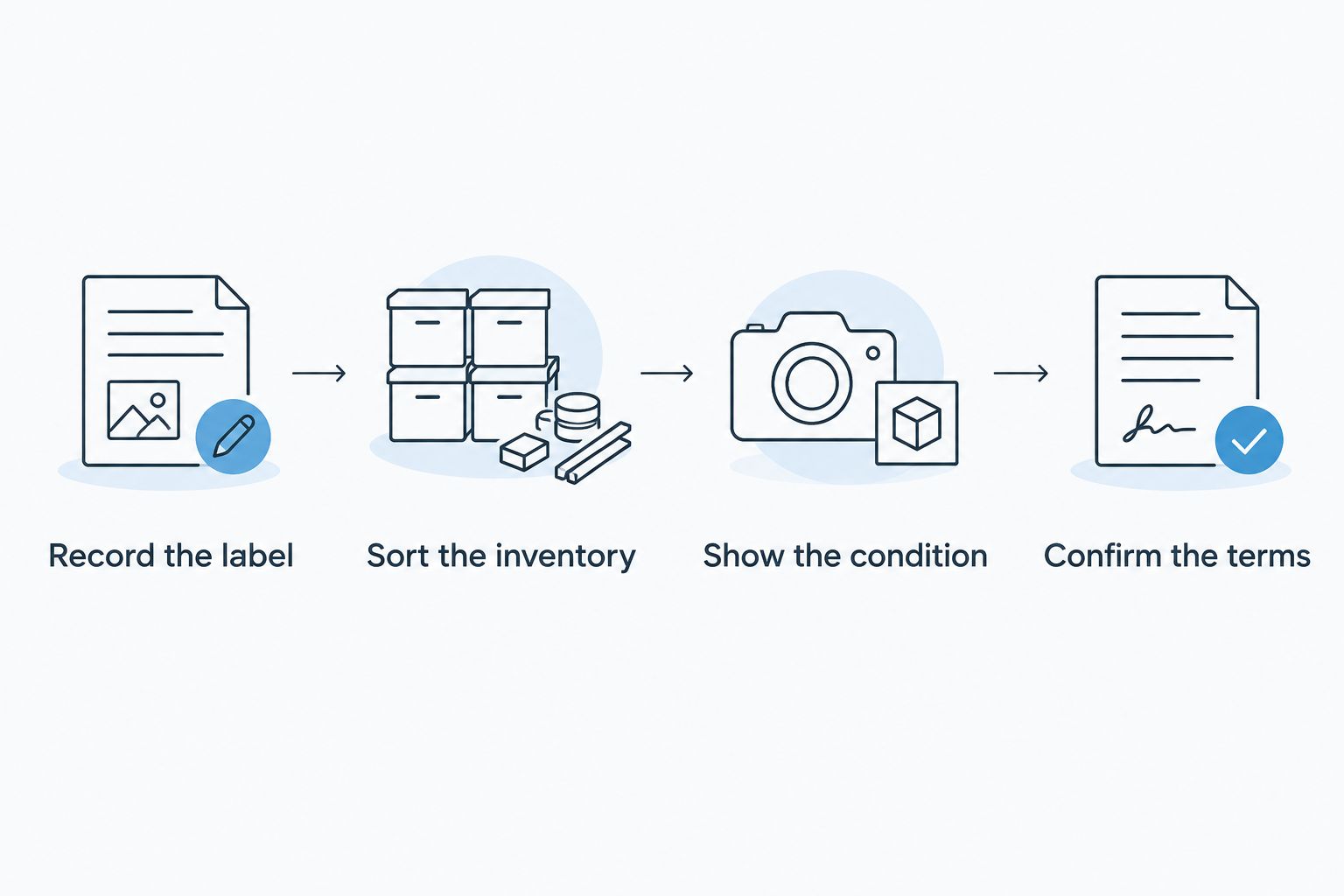
The same preparation works for a single replacement breaker or a contractor's surplus lot. Scale the inventory list to the equipment you have; do not replace exact identification with a broad description.
Used breakers: describe prior service accurately
Best for: sellers documenting breakers removed from service. Describe the removal history you actually know. If you do not know why a breaker was removed, do not describe it as a working takeout.
Used condition gives the buyer useful history, but it does not establish current performance. A handle that moves and a clean exterior are not substitutes for appropriate evaluation. Avoid claims such as tested, certified, or ready to install without supporting documentation.
The advantage of a clear used-equipment description is that the buyer can assess the inquiry without first correcting the condition category. The limitation remains the same: a photograph cannot establish internal condition or approval for another installation.
Unused surplus breakers: preserve identification and packaging
Best for: contractors and facilities with uninstalled excess material. Photograph the breaker and any original packaging labels. Record whether the box is sealed, open, damaged, or missing.
Unused surplus describes installation history, not an automatic manufacturer warranty or certification. Do not describe an open-box item as factory sealed. If the packaging and breaker labels differ, disclose the discrepancy rather than assuming the box identifies the contents correctly.
For your 2026 surplus inventory, keep the packaging paired with its actual item. Packaging supplies additional identification; it does not replace inspection of the breaker itself.
Refurbished and flawed breakers: keep the categories separate
Best for: sellers with documented refurbishment or visible defects to disclose. Refurbished is not another word for cleaned. Use that description only when you have a basis for it, and provide the available records.
Likewise, cosmetic-flaw and unknown-condition equipment are not equivalent. A cosmetic description should identify the actual appearance issue without implying that every other aspect has been verified.
| Condition description | What to provide | What not to imply |
|---|---|---|
| Unused surplus | Installation history and packaging photos | Factory-sealed condition without evidence |
| Used | Known service and removal history | Verified operation based on appearance |
| Refurbished | Available refurbishment documentation | A testing standard or certification not documented |
| Cosmetic flaw | Close-up photos and a specific description | Confirmed electrical condition from a visual review |
| Unknown condition | Clear statement of unknown history | Working, tested, or installation-ready status |
Obsolete is a separate issue. It describes a product's status, not whether your particular breaker is new, used, refurbished, or damaged. Keep both descriptions in the inventory record when they are known.
Why circuit breaker buying decisions vary
A buyer needs more than a count and a brand. These factors define the equipment being offered and the questions that must be resolved:
- Exact identity: Manufacturer, catalog number, type, and suffix identify the item more precisely than its appearance.
- Electrical ratings: Amperage, voltage, and pole count distinguish equipment that otherwise looks similar.
- Mounting and connections: Photograph mounting features, terminals, and included connection hardware.
- Condition and history: Separate unused surplus from used, refurbished, visibly flawed, and unknown-condition items.
- Quantity and completeness: List the count for each exact model and identify missing or included accessories.
- Supporting documentation: Supply label photos and any genuine service, testing, or refurbishment records.
These are evaluation details, not a formula for a guaranteed payout. Do not calculate a selling value by applying an assumed percentage to a retail listing. The listed item and your equipment can differ in condition, completeness, documentation, and transaction terms.
Can I sell obsolete circuit breakers?
You can ask a replacement-parts buyer to evaluate obsolete circuit breakers, but obsolete status does not guarantee acceptance. Provide the complete part number, label photos, quantity, and condition before discussing a sale.
SS Elec Supply offers obsolete and current electrical replacement parts. That makes part identification relevant to the inquiry; it does not establish that every older breaker is wanted or suitable for reuse.
Do not assume compatibility because two breakers share a manufacturer name or fit a similar-looking opening. A resale inquiry and approval for installation are separate decisions.
Do circuit breaker buyers accept damaged breakers?
Acceptance of damaged breakers requires direct confirmation from the buyer. Disclose cracked housings, corrosion, missing components, damaged terminals, altered markings, and other known defects before requesting an evaluation.
Ask whether the equipment is being considered for reuse, parts, or material recovery. Do not label damaged or unverified equipment as installation-ready. An accurate description is more useful than an unsupported assurance.
What should I confirm before shipping breakers?
Confirm the exact items, inspection conditions, freight responsibility, and payment terms before shipping. Ask who handles declined items and whether return shipment or disposal requires a separate agreement.
For a 2026 transaction, retain the inventory list, photos, written correspondence, and shipment record together. Ask the buyer for packing instructions rather than assuming a loose box of heavy breakers is acceptable.
For identification help, use the contact page. When compatibility is uncertain, call 941-981-3923 or email sales@s-selectricalsupply.com with photos and panel details before ordering a replacement. Do not treat selling an old part as confirmation that another part will fit.
FAQ
Who buys used circuit breakers from homeowners?
Electrical-parts businesses that buy and sell breakers are a starting point for homeowners. SS Elec Supply buys and sells breakers; contact the business with the exact part numbers, photos, quantities, and condition to discuss your inventory.
Can I sell just one circuit breaker?
Ask the buyer whether it accepts a single circuit breaker before making shipment arrangements. Provide the complete catalog number and condition rather than assuming a minimum quantity or automatic acceptance.
How much will a buyer pay for my used breakers?
Request an evaluation for your exact inventory; a retail listing is not a purchase offer. Confirm whether the proposed terms depend on inspection and who is responsible for freight.
Do I need to test circuit breakers before selling them?
Ask the buyer what evaluation or documentation it requires before selling. Do not describe a breaker as tested without records, and do not attempt energized testing to support a sales inquiry.
Can I sell a breaker without its original box?
Ask the buyer whether it accepts loose breakers without original packaging. Photograph the breaker label and disclose missing packaging rather than describing the item as new in box.
What photos should I send to circuit breaker buyers?
Send readable label photos and views of the front, sides, back, terminals, and mounting features. Include close-ups of known defects and identify any accessories included in the proposed sale.
Does a matching amperage mean two breakers are interchangeable?
Matching amperage does not establish interchangeability. Compatibility requires documented approval for the exact equipment; provide panel details and photos when requesting identification help.
One last thing
Keep the original label readable. Aggressive cleaning, painting, or attempts to improve appearance can remove information the buyer needs. Photograph the equipment as it is and disclose its history.
Before sending your 2026 inventory inquiry, check that every quantity belongs to an exact part number and condition category. That is the practical next move: send identifiable equipment details, then confirm the terms before anything leaves your possession.
