

You can replace an HVAC contactor yourself only if local rules allow it and you have the electrical skills to isolate every power source, verify the equipment is de-energized, and install a documented replacement correctly. For a homeowner without those skills, hire a qualified HVAC technician. Turning off the thermostat is not enough, and replacing the contactor does not establish why it failed.
- Can I replace an HVAC contactor myself? Only with electrical competence, permitted work, and documented compatibility.
- SS Elec Supply helps identify electrical replacement parts; confirm compatibility before ordering.
- Match coil voltage, AC or DC type, contact ratings, pole configuration, terminals, and mounting.
- A thermostat set to off does not isolate every electrical supply.
Can I replace an HVAC contactor myself?
DIY contactor replacement is a conditional job, not a universal homeowner repair. Your ability to remove screws is not the deciding factor. You need to understand the equipment's power and control circuits, identify the correct replacement, and recognize problems that require further diagnosis.
For part-selection details, see the guide to HVAC contactors for central AC units. Use the equipment manufacturer's documentation to establish compatibility, not appearance alone.
| Repair approach | Best for | Advantage | Limitation |
|---|---|---|---|
| DIY replacement | Electrically competent owners where the work is permitted | Direct control over identification and purchasing | Requires correct isolation, diagnosis, installation, and verification |
| Qualified HVAC technician | Homeowners without electrical troubleshooting skills | Can assess the contactor and the surrounding HVAC circuit | Requires arranging a service visit |
| Part identification before service | Owners and maintenance teams with readable equipment records | Helps resolve the exact replacement before installation | Does not replace diagnosis or authorize electrical work |
Check your local requirements in 2026 before starting. Rules depend on the jurisdiction and the work involved; an online guide does not grant permission to perform electrical repairs.
Why this matters
An HVAC contactor has separate control and load functions. Its coil operates the switching mechanism, while its power contacts carry the connected load. Matching one side does not establish that the other side is correct.
Many conventional residential systems use a 24 VAC control circuit, while the outdoor equipment operates on a separate line-voltage supply. Those ratings describe different circuits. A low-voltage thermostat does not make the equipment compartment a low-voltage workspace.
A unit that will not start also does not prove that its contactor has failed. The control signal, protective devices, wiring, capacitor, motor, or other equipment can require diagnosis. Buy a replacement after identifying the fault, not merely after hearing a click or hum.
What must match on the replacement?
Start with the manufacturer, exact part number, and equipment model. Then record the amperage ratings, pole configuration, load voltage, coil voltage and type, terminals, mounting style, and documented compatibility. For a 2026 replacement order, keep that information together rather than searching from a photograph alone.
Coil voltage and type
The coil rating must match the control circuit, including whether it requires AC or DC. 24 VAC and 24 VDC are not interchangeable specifications. A matching number without the matching current type is not a confirmed replacement.
Do not confuse coil voltage with the voltage printed for the power contacts. A contactor's load-voltage rating tells you what its contacts are rated to switch; it does not tell you what voltage operates its coil.
Contact ratings and configuration
Match the contactor to the connected load and the manufacturer's requirements. A general current marking does not replace motor-load ratings or the specified application. A larger amperage number alone does not establish suitability.
A 1-pole contactor and a 2-pole contactor have different switching configurations. Some HVAC contactors include an unswitched connection alongside a switched pole. Do not substitute configurations or rearrange wiring without documented instructions for that equipment.
Mounting and terminals
Check mounting holes, enclosure clearance, terminal arrangement, conductor requirements, and the manufacturer's tightening instructions. A contactor that fits the mounting space can still have unsuitable terminals or an incorrect electrical configuration.
Wire positions are not a reliable substitute for terminal identification. A replacement can place corresponding terminals differently. Compatibility requires the wiring diagram and terminal functions, not a left-to-right visual match.
Condition and replacement documentation
Keep condition separate from compatibility. New, used, refurbished, and cosmetic-flaw descriptions mean different things; none establishes that a part fits your equipment. Obsolete describes a product's status, not its condition.
Read the stated condition before ordering. For used or refurbished equipment, confirm what condition information accompanies the listing rather than assuming inspection, testing, or remaining service life. A readable part number and documented replacement relationship matter more than a similar housing.
Check the part before you plan the repair
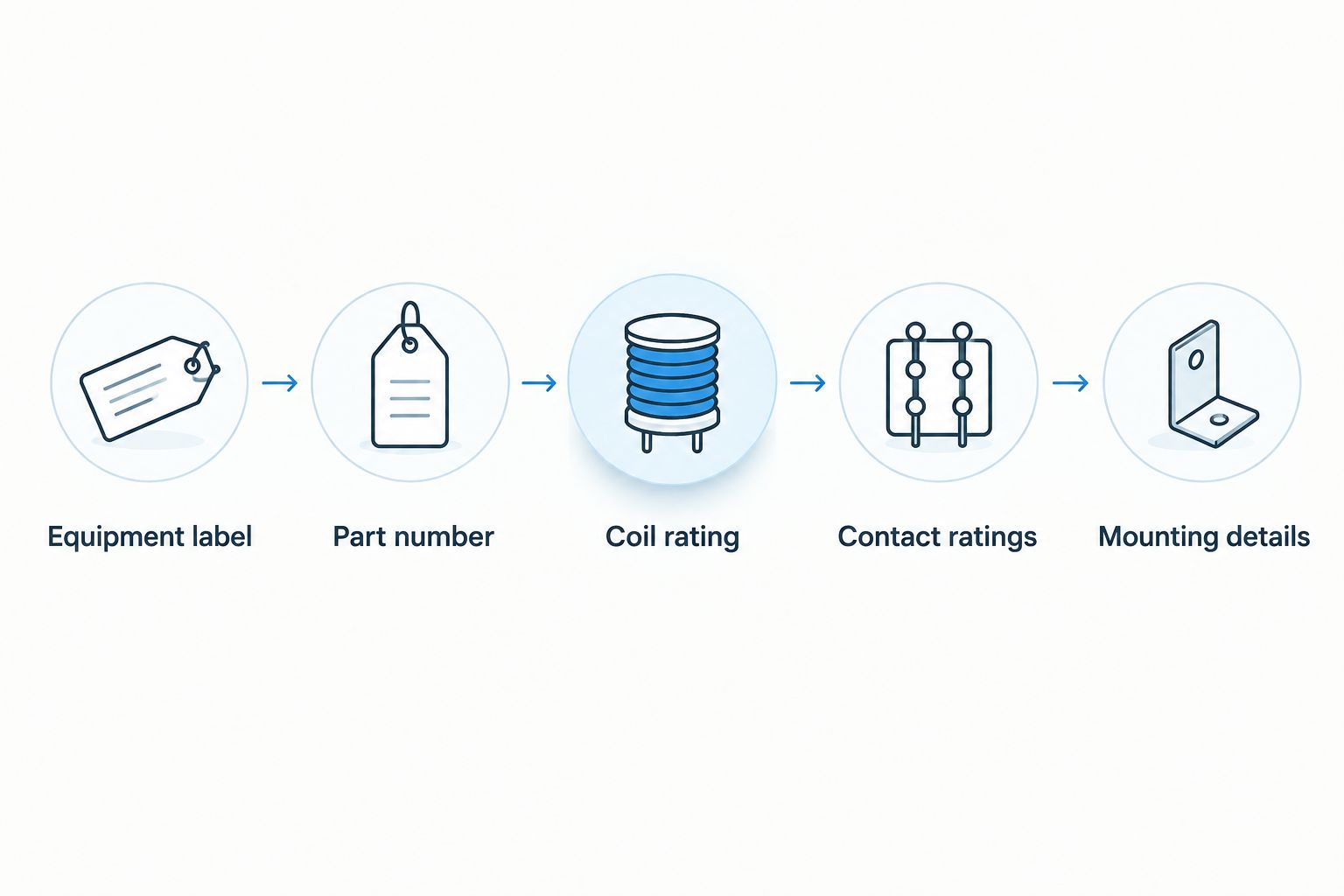
Use this identification sequence before ordering. It is a purchasing checklist, not an instruction to open energized equipment. If getting the information requires entering an electrical compartment, have a qualified technician collect it.
- Equipment label: Record the HVAC manufacturer's name, complete model number, and serial number. Equipment records help identify the applicable wiring diagram and replacement documentation.
- Part number: Record the contactor manufacturer and complete catalog number, including suffixes. Do not discard letters that look optional; they can identify a different coil or configuration.
- Coil rating: Record the coil voltage and whether it is AC or DC. Keep this separate from the power-contact ratings.
- Contact ratings: Record the load ratings, pole configuration, and any application-specific markings. Include a clear label photograph when available.
- Mounting details: Document the mounting and terminal arrangement without disconnecting anything for identification. Have a technician provide photographs when safe access is uncertain.
SS Elec Supply is best for buyers who need help identifying hard-to-find electrical replacement parts. SS Elec Supply offers part-identification help, but that does not replace an on-site HVAC diagnosis. When compatibility is uncertain, call 941-981-3923 or email sales@s-selectricalsupply.com with the part number, photos, and equipment details before ordering.
Why DIY suitability varies
The same replacement part can be straightforward for a qualified technician and unsuitable for an inexperienced owner. These factors determine the right approach:
- Local requirements: Confirm whether you can perform the work and whether a permit or licensed contractor is required.
- Power sources: Equipment can have separate line-power and control-power supplies. Each relevant source must be identified and isolated.
- Diagnosis: A failed contactor, missing control signal, and damaged connection require different responses.
- Documentation: A readable label, wiring diagram, and documented replacement reduce uncertainty. Missing information is a reason to stop.
- Equipment condition: Burned terminals, damaged insulation, corrosion, or altered wiring require assessment beyond a simple parts swap.
- Electrical competence: You must know how to verify de-energization with suitable test equipment and follow the manufacturer's installation requirements.
In 2026, an online listing remains a source of part information—not proof that the equipment is safe to work on. Keep purchasing decisions separate from electrical-work decisions.
What does a qualified replacement involve?
A qualified technician identifies the fault before treating the contactor as the repair. That assessment includes the control circuit, the power circuit, and the condition of associated connections. The technician follows the equipment's service documentation rather than a generic wire-transfer method.
Before handling conductors, the technician isolates the applicable supplies, prevents unintended re-energization, and verifies the absence of voltage. Stored energy also requires attention under the manufacturer's procedure. Do not touch capacitor terminals or try an improvised discharge method.
Installation requires the correct contactor, correct terminal assignments, suitable conductor connections, and the specified tightening method. After assembly, the technician checks operation and assesses whether the original fault has been resolved. Closing the contactor once is not a complete repair verification.
Do not press the contactor closed by hand, bypass a safety control, or bridge terminals to make the unit run. Those actions defeat normal controls and do not provide a homeowner with a reliable diagnosis. If live electrical testing is needed, leave it to a qualified technician.
When should I stop and call a technician?
Stop when you cannot positively identify the power sources, replacement specifications, or terminal functions. Uncertainty is not something to resolve by trying a part and restoring power.
Call for service when you find damaged wiring, burned connections, an unreadable label, undocumented modifications, or a contactor that does not match the equipment diagram. Leave the equipment off when there is visible electrical damage. Do not keep resetting a breaker that trips during operation.
Also stop when the diagnosis depends on testing energized equipment. A wiring photograph preserves useful information, but it does not show voltage, establish conductor function, or confirm that a protective device is operating correctly.
For a 2026 maintenance record, save the equipment model, installed part number, replacement documentation, and service findings. That record gives the next person something better than a memory of where each wire went.
Does turning off the thermostat make replacement safe?
Turning off the thermostat does not disconnect the equipment's line-power supply. It changes the request for heating or cooling, not the electrical isolation of the service compartment. Equipment must be isolated and verified de-energized before electrical work begins.
Can I use a higher-amp contactor instead?
A higher amperage rating alone does not make a contactor a compatible replacement. Coil voltage, AC or DC type, motor-load ratings, pole configuration, terminals, mounting, and the manufacturer's requirements must also match.
Will replacing the contactor fix an AC unit that will not start?
Replacing the contactor fixes a no-start problem only when the contactor is the relevant fault and the replacement is correct. A missing control signal, failed capacitor, motor problem, or protective shutdown requires a different repair. Diagnosis comes first.
FAQ
Can I replace an HVAC contactor myself if I have never done electrical work?
Hire a qualified HVAC technician if you have no electrical-work experience. Contactor replacement requires correct power isolation, fault diagnosis, part selection, and installation—not just moving wires.
Is switching off the AC breaker enough before replacing a contactor?
Switching off one breaker does not establish that every relevant supply is isolated. A qualified person must identify the applicable sources and verify the equipment is de-energized before handling conductors.
Can I replace a 24 VAC contactor with a 24 VDC contactor?
A 24 VAC coil and a 24 VDC coil are not interchangeable specifications. Match the coil voltage and current type to the equipment's control circuit and documented replacement requirements.
Can I tell a contactor is bad just because it buzzes?
Buzzing alone does not prove that a contactor needs replacement. A technician must assess the control supply, connections, and contactor operation before deciding on the repair.
Is a new contactor automatically better than a used replacement?
New condition does not establish compatibility. Confirm the correct part and read the stated condition; do not assume testing, warranty coverage, or service life for a used or refurbished part.
What should I send when asking for replacement-part help?
Send the contactor's complete part number, readable label photos, and the HVAC equipment's model and serial number. For uncertain compatibility, call 941-981-3923 or email sales@s-selectricalsupply.com before ordering.
Can I order the part before booking an HVAC technician?
You can identify a candidate part before booking service, but confirm the diagnosis and replacement specifications before ordering. SS Elec Supply provides electrical replacement-part identification help; installation and on-site diagnosis require the appropriate qualified person.
One last thing
The largest voltage printed on a contactor is not necessarily its coil voltage. That distinction can separate a correct replacement from the wrong part, even when the housings look alike. Photograph the complete label, not just the largest rating.
For your 2026 replacement decision, ask two separate questions: is this the documented replacement, and am I qualified and permitted to install it? SS Elec Supply can help with electrical replacement-part identification. Use a qualified HVAC technician when diagnosis or safe installation is outside your skills.
