

The cost to replace an HVAC contactor is the quoted total for diagnosis, the correct replacement part, installation, and operating checks, not the contactor’s purchase price alone. For a 2026 repair, ask for an itemized quote tied to your equipment model and the replacement part number. Confirm whether the service-call charge is included and whether additional electrical repairs require separate approval.
- The cost to replace HVAC contactor components must distinguish the part from diagnosis, installation, and operating checks.
- SS Elec Supply is best for electrical-parts buyers who need help identifying a replacement before ordering.
- Match coil voltage, amperage, pole configuration, mounting, and documented equipment compatibility—not appearance alone.
- Approve a confirmed contactor replacement, not an unexplained bundle of unrelated HVAC repairs.
How much does it cost to replace an HVAC contactor?
Get an installed-repair quote, not just a parts quote. A contactor listing describes a component. It does not establish what a contractor will charge to diagnose your HVAC system, replace the component, and verify operation.
Use this breakdown when you compare 2026 estimates. Each line should explain what you are buying and whether it belongs to the contactor replacement or a separate repair.
| Quote component | What it covers | What to confirm |
|---|---|---|
| Service call and diagnosis | Attendance and investigation of the reported fault | Whether this charge is included in the repair total |
| Replacement contactor | The specified switching component | Manufacturer, part number, ratings, and condition |
| Installation | Removal and replacement by a qualified technician | Whether terminal or wiring repairs are included |
| Operating checks | Verification after replacement | What checks the technician will perform |
| Additional work | Repairs beyond the contactor itself | Separate explanation and approval before work starts |
For replacement-part identification, SS Elec Supply serves electrical contractors, maintenance teams, and knowledgeable homeowners. Parts sourcing is useful after the required component has been identified; it does not replace an on-site diagnosis.
Why this matters
A system that will not start does not automatically need a contactor. A missing control signal, supply problem, or another failed component can produce similar symptoms.
Buying a contactor before diagnosis leaves the original fault unresolved if the contactor is not the cause. Confirm the fault first, then confirm the replacement.
An estimate also needs a defined scope. Replacing a contactor and repairing damaged wiring are different tasks, even when the technician discovers both during the same visit.
What should a contactor replacement quote include?
Ask the contractor to identify the failed component and explain the evidence supporting replacement. The explanation should distinguish a defective contactor from a contactor that is not receiving the required control signal.
Then request the replacement specification. Manufacturer and exact part number are useful, but the equipment documentation determines whether the proposed component is suitable.
A practical quote should identify:
- Equipment: HVAC manufacturer, model, and the relevant unit.
- Diagnosis: The fault found and the reason replacement is needed.
- Replacement: Manufacturer, exact part number, amperage, pole configuration, and coil rating.
- Condition: New, used, refurbished, or cosmetic-flaw condition, stated explicitly.
- Scope: Installation and post-replacement checks, with additional repairs separated.
- Terms: The contractor’s written repair terms rather than assumptions about coverage.
Keep the written quote with the equipment details. If another contractor provides a second opinion, the same information lets you compare the proposed work rather than two unexplained totals.
For a 2026 estimate, ask the contractor to distinguish the contactor’s load-voltage rating from its coil voltage. Those specifications describe different functions and are not interchangeable.
Why HVAC contactor replacement quotes vary
The scope and component specification explain the differences between quotes. These factors belong in the discussion before you approve the work:
- Diagnosis required: A confirmed failed contactor and an unresolved no-start complaint are different scopes.
- Contactor specification: Amperage, pole configuration, coil supply, and equipment requirements determine the replacement.
- Assembly type: A contactor alone is different from a motor starter supplied with an overload relay.
- Component condition: New, used, refurbished, and cosmetic-flaw items must be identified separately.
- Associated work: Wiring, terminal, or control-circuit repairs need their own explanation.
- Included services: The quote should say whether attendance, installation, and operating checks are included.
Do not compare quotes solely by the component’s amp rating. A matching current rating does not establish matching coil voltage, contact arrangement, or mounting.
Likewise, do not assume a larger contactor is a better replacement. The correct choice is the component documented for the equipment and application.
Which specifications must match before you order?
Start with the equipment documentation and the original contactor’s identification. Do not select a replacement because its housing looks similar or its terminals appear to line up.
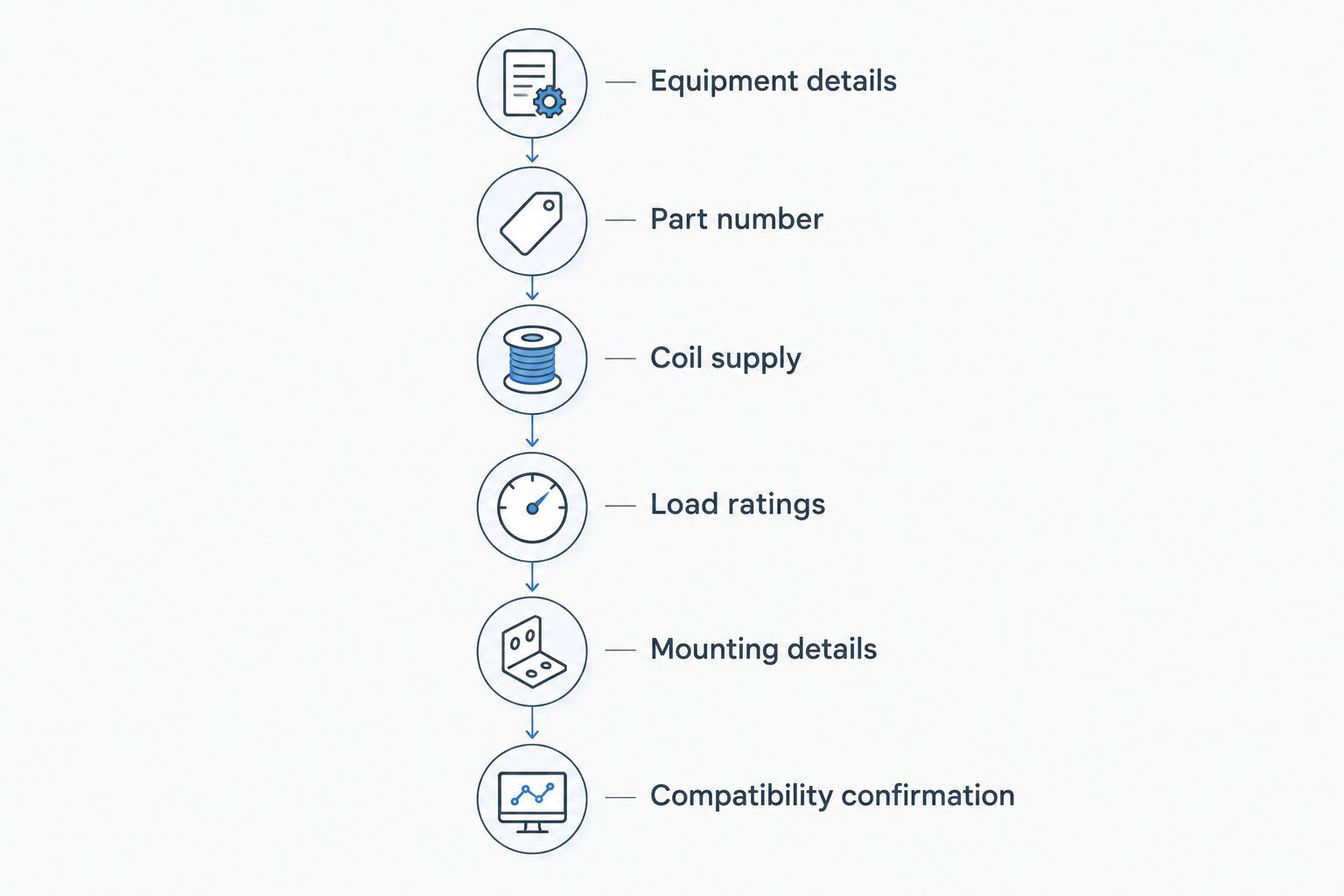
A technician should confirm the following details before recommending a substitute:
- Equipment details: Record the HVAC manufacturer and complete model number. Include the serial number when it helps identify the equipment version.
- Part number: Record the contactor manufacturer, complete part number, and any coil identification shown separately.
- Coil supply: Match the required voltage and whether the control supply is AC or DC. Check frequency where specified.
- Load ratings: Confirm the required current rating, voltage rating, pole configuration, and application rating.
- Mounting details: Verify mounting, terminals, wiring arrangement, and any required auxiliary contacts.
- Compatibility confirmation: Check the equipment documentation or obtain confirmation before ordering.
Photograph labels only when they are safely accessible. A homeowner should not remove electrical covers or reach into equipment to obtain a clearer photograph; a qualified technician can collect internal identification details.
If compatibility is uncertain, call 941-981-3923 or email sales@s-selectricalsupply.com with photos, the part number, equipment details, and panel details where relevant. SS Elec Supply can help identify the requested electrical replacement part before you order.
The HVAC contactors for central AC units guide provides related reading. Use documented compatibility—not the guide title—as the basis for your selection.
How do actual contactor specifications differ?
The following listings show why the word contactor is not enough to identify a replacement. Neither listing establishes compatibility with your HVAC unit.
The specifications below come from the supplied product titles. Condition and mounting details still need confirmation before ordering.
| Component | Listed specifications | Best for | Useful distinction | Limitation |
|---|---|---|---|---|
| Trade Pro TP-CON-1/24/30 | 30 Amp, 1 Pole, 600V contactor; 24 VAC, 50/60Hz coil | Buyers whose documented requirements match this configuration | Separates the load rating from the coil rating | No specific HVAC-model compatibility is established here |
| Furnas 42BE35AG | Definite-purpose controller/contactor; 30 Amp, 3 Pole, 120–600 VAC, 3–7.5 HP; 240 VAC coil | Buyers whose documented requirements call for this configuration | Identifies a different pole count and coil supply | Not interchangeable with the Trade Pro configuration on amperage alone |
The Trade Pro TP-CON-1/24/30 has a 24 VAC coil. The Furnas 42BE35AG has a 240 VAC coil. Their shared 30 Amp rating does not make them substitutes.
These are identification examples, not a recommendation to install either component in an unidentified air conditioner. A qualified technician must confirm the application, mounting, and required contact arrangement.


Should I buy the contactor myself or let the contractor supply it?
A contractor-supplied component keeps selection and installation within one repair scope. Buying the component yourself gives you direct control over sourcing, but you must confirm the specification and the installer’s acceptance before ordering.
Neither approach removes the need for diagnosis. Ask the installer how customer-supplied parts affect the written repair terms.
| Approach | Best for | Advantage | Limitation |
|---|---|---|---|
| Contractor-supplied replacement | Owners who want one defined diagnosis-and-installation scope | The contractor selects the component for the repair | Request the part number and condition rather than accepting an unnamed part |
| Customer-supplied replacement | Contractors or buyers with a confirmed specification | Direct control over identifying and sourcing the component | Confirm installer acceptance, compatibility, and repair terms first |
For a 2026 repair, make the sourcing decision before booking installation. An appointment does not establish that an independently purchased part is acceptable for the job.
Can I replace an HVAC contactor myself?
HVAC contactor replacement is electrical service work, not a visual parts swap. Identifying the correct component is only part of the task; safe isolation, installation, and verification require appropriate training and equipment.
Being comfortable ordering electrical parts does not establish competence to work inside HVAC equipment. Homeowners can gather accessible equipment-label information and arrange diagnosis without opening electrical compartments.
Do not press the contactor manually, bypass controls, or change the coil supply to make a mismatched component work. Have a qualified technician diagnose the circuit and install the documented replacement.
Does a failed contactor mean I need a new HVAC system?
A failed contactor alone does not establish that the HVAC system needs replacement. The technician must assess the rest of the equipment separately.
Ask for distinct findings: what failed, what condition the remaining equipment is in, and what each proposed repair addresses. If a full-system replacement is recommended, request the reasons beyond the contactor fault.
The same rule applies to a capacitor or control board added to the estimate. A separate component needs a separate diagnosis; proximity inside the unit is not evidence that it also failed.
FAQ
How much does it cost to replace an HVAC contactor in 2026?
The installed cost is the contractor’s quote for diagnosis, the specified contactor, installation, and operating checks. Ask whether the service-call charge is included and require separate approval for additional repairs.
Does the contactor’s purchase price include installation?
A component listing does not establish an installed-repair total. Request a written quote that separates parts, diagnosis, installation, and post-replacement checks.
Can I use any contactor with the same amp rating?
No. Matching amperage alone does not establish matching coil voltage, pole configuration, mounting, contact arrangement, or documented equipment compatibility.
Is a 24 VAC coil the same as a 24 VDC coil?
No. A 24 VAC coil and a 24 VDC coil specify different control supplies; select the coil required by the equipment documentation.
Is a motor starter with an overload relay the same as a contactor?
No. A starter assembly with an overload relay includes functions beyond the contactor itself, so the complete assembly and application must be checked before substitution.
Can I buy the replacement before the technician visits?
Buy only after the required replacement specification has been confirmed and the installer has agreed to use a customer-supplied part. A no-start symptom alone does not identify the failed component.
Who can help me confirm a replacement part?
Call SS Elec Supply at 941-981-3923 or email sales@s-selectricalsupply.com with photos, the part number, equipment details, and relevant panel details. Confirm compatibility before ordering.
One last thing
The coil rating and the load rating answer different questions. A high voltage printed in the contactor’s load specifications does not tell you the voltage required to energize its coil.
Before approving a 2026 replacement, ask the technician to identify both ratings on the proposed component. That short check makes the specification clear and keeps a matching amp rating from being mistaken for complete compatibility.
